Showing posts with label language. Show all posts

04 August 2009

Cuish. Magazine. Expedite.

I am in all kinds of love with this NYTimes piece containing a list of code words for use in telegrams. They are infinitely more sophistimicated than the LOLz and WTFs from our age of text messages and Google chats. Hell, I might even start twittering if we all agree to start using words such as 'morisco'* and 'babylonite'**.

I actually have a Twitter account, but so far the appeal of using it has alluded me. Sure, every once in a while I like to read through the tweets of the few friends I'm 'following', but any more than that and I fear it would become a hideous time suck of proportions greater than my Google Reader and Facebook combined.

Do you Twitter? If so, please explain to me its advantages over, say, telegrams.

*Money no object.
**Please provide bail immediately.

22 May 2009

Reasons to learn English

Oldies but goodies - a couple language school commercials.


If you have the sound turned on, this next one is NSFW. If you don't have the sound turned on, it's not worth watching.

13 April 2009

I dig a pony

English words are adapted for use in German all the time. It's not uncommon to hear a sentence in which half the words are English, especially if the speaker is young and hip. To a much lesser extent, the Italians do this, too. Often the meaning of the word stays the same, or at least mostly the same, but sometimes the definition gets completely scrapped for a new, unrelated one. Smoking. Mobbing. Pony.*

Back when I worked in Milan, the receptionist called me at my desk one day with an important message: "C'è un pony per Lei." There's a pony for you. I imagined a barnyard animal standing at her desk waiting for me to come get it. I tried to explain to my Italian colleagues why their use of the word pony was so amusing, but they just thought I was a little nuts.

As you probably guessed from that little story, in Italian pony means "package". (No, not that kind of package. Pervert.) As in, something that could be delivered by the Pony Express. If the Pony Express existed now, and in Italy. Which it does not. And even if it did, I doubt it would deliver ponies (although Pony Express certainly would be the obvious name choice for a service specializing in pony delivery). But perhaps I digress.

The Germans aren't so silly. They know better than to call a package a pony. They know that a pony isn't related to delivery services, but rather to hair. Thinking pony tail? Not so fast... In German, a pony is what we in English refer to as bangs (fringe, to the Brits). Any guesses on the origin of that one?


* In German, Smoking means tuxedo, and Mobbing means harassment (usually by a group in a work or school environment).

-----
In unrelated news, my new computer arrives tomorrow. Yay! Can't wait to get back to my regular diet of internet access (and blogging).

04 October 2008

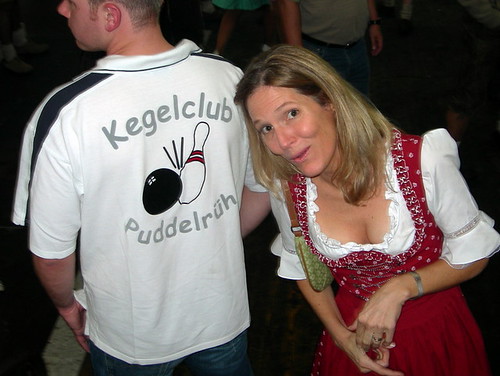
There's a club for everything

Really? This is a team sport? Practiced by men?


OK, listen up Germans. I know how much you like to use English words (such as, say, 'club'). But sometimes, when you only put part of what you are saying in English, and leave part in German, you can end up with a meaning you never intended...

I don't think these guys ever figured out why we were so fascinated with their shirts.

19 September 2008

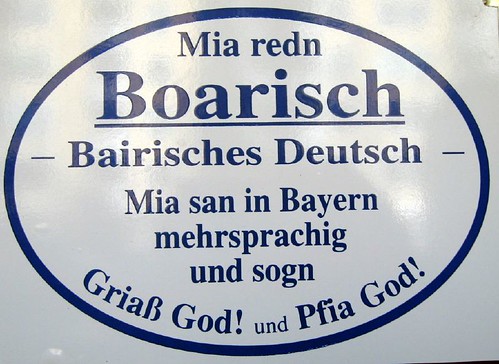
Does Oktoberfest have its own language?

All over the place I've been hearing references to Bayerisch (the Bavarian language) in connection to Oktoberfest. The official website has an English-Bayerisch dictionary. A friend gave me an Oktoberfest song book* which also includes a Bayerisch phrase guide (and an interview with Roberto Blanco, of all people. WTF? All I know is that if he's performing at Oktoberfest, I am so there.) Advertisements seem to be tossing in a Bayerisch phrase or two all over the city.

This confuses me a bit ("this" meaning the whole Bayerisch thing, although the Roberto Blanco thing also has me a little baffled). First of all, despite warnings to the contrary from non-Bavarian Germans, Bayerisch is not the default language in Munich. German is. People don't speak Bayerisch at me,** and they don't speak it around me. In my eight months here, I have heard very little Bayerisch, and trust me, I do a lot of eavesdropping. You want to see a city where people speak dialect instead of a real language? Go try Zurich, because Munich is pretty solidly a convert to the Hochdeutsch camp. I hear more English and Italian here than I do Bayerisch. Secondly, rumor has it that Oktoberfest is sooooo commercial and so very overrun with tourists that the locals, for the most part, are oh-so-fed-up, and don't even hardly go to the Wies'n anymore.

So whom, exactly, is going to be speaking all this Bayerisch at me? Is it one of those scenes like Colonial Williamsburg or a Renaissance fair where the employees get all crazy into character and refuse to speak like a normal person? Somehow I'm skeptical. But just in case, I'm arming myself with a few key vocabulary words and phrases. Feel free to print this out and carry it around as a cheat-sheet. Oktoberfest starts tomorrow!

Z ' dringga mächd i biddschee a Mass! - I'd like to have a beer.
biddscheen - please / you're welcome.
Deaf i mi zu dia hisizn? - May I sit down here?
Naa - no
Zoin - The bill, please.
aufmandeln - to aggrandize oneself, especially when you do not find any free seats in the beer tents.
aufstöin - to donate a beer.
Bierdimpfe - notorious beer drinker, "tavern potato".
Fetznrausch - totally drunk.
Gaudinockerln - luxuriant breasts
Weißbia - wheat beer (only in the smaller beer tents at Oktoberfest)
Deaf i Dia a Busserl gem. - I'd like to give you a kiss.
----
* The Oktoberfest Song Book comes on a long blue ribbon, so that you can hang it around your neck. Very handy!
** As if trying to prove me wrong, a little old lady actually came up to me and spoke Bayerisch in the grocery store today.

24 July 2008

A little German leisure reading

So, in my quest to improve my language skills, I have switched most of my leisure reading over to German. So far I have finished two novels in German, and I'm looking for more.

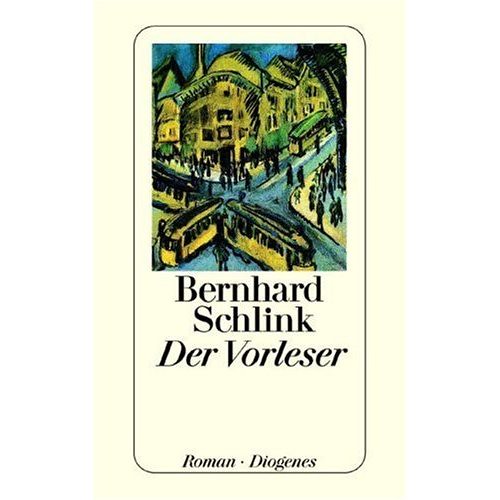
The first novel I read, at the suggestion of Heza and Alex, was Der Vorleser by Bernhard Schlink. It started out a bit slow, but the pace picked up before I lost interest. The level was great - I was able to read and understand almost everything without stopping to look words up, although there were definitely new words in the text (for when I was in the looking-up kind of mood). What I particularly liked about the story line was that it was uniquely German, drawing me into parts of German history I had not thought about before, at a level I could easily follow and understand. I see that Mr. Schlink is a prolific writer; perhaps I will give another book of his a go.

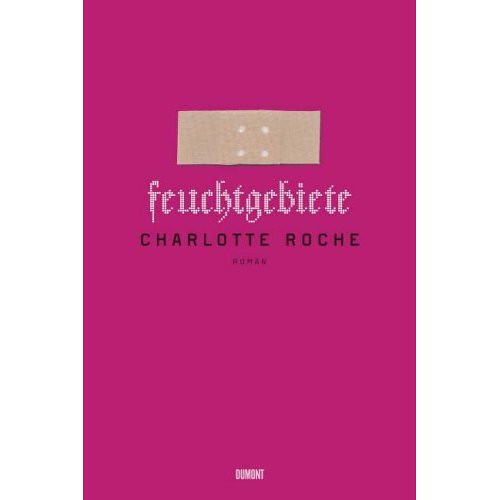
The second German novel I read was the infamous Feuchtgebiete by Charlotte Roche. Although I expected my knowledge of German slang to be challenged, I have to say that I ended up being almost disappointed at the lack of new and scandalous vocabulary it offered. I suppose all those issues of Bravo (link possibly NSFW) I read during my Halle days really paid off! The book was also a bit of a let-down in the content department; based on all the uproar it has caused, I expected it to shock and offend my prude American sensibilities much more than it did. Although the book did make me physically gag on a couple of occasions, my reaction was more to the hygiene elements than the sexual ones.

Despite these disappointments, overall I'll call Feuchtgebiete a decent read. The pace was quick, and for the most part the plot was interesting enough to keep me entertained on the plane to California. It might have been less interesting to read in my native language, since it would have lost its educational appeal (although, I suppose, it does have something in the way of education to offer on the topic of raising avocados, too), but as a German-learning tool I'll give it a thumbs up.

Any suggestions for what I should read next? I prefer to read in the original language (ie, I'm looking for books written in German). They don't have to be novels, but my other preferred genre is humorous nonfiction (ala David Sedaris and Bill Bryson), and I'm not sure my German sense of humor is sophisticated enough to tackle that. I like novels that are quick reads but with some substance - no romance novels or Sweet Valley High, but also no War and Peace. Think good airplane reading.

16 July 2008

Learning German at the Volkshochschule

Although I haven't quite implemented everything on my learning German with overwhelming force list, for the past month and a half I've been taking a German class at the Münchner Volkshochschule. A Volkshochschule is kind of like a community college or an adult education center, and you can find one in pretty much every German city. Course offerings cover a wide array of subjects, from art to business to to swimming to foreign languages.

The best thing about Volkshochschule courses is that they are extremely affordable. I had heard mixed reviews about the quality of the German classes, but I decided to give it a try. I've taken language courses at much pricier schools, such as the Goethe Institut and Berlitz, and I'd give them mixed reviews, too. It really depends on the teacher most of the time, and at the Volkshochschule I totally lucked out. Our teacher was engaging and interesting. She made sure we were challenged, while also giving us plenty of praise.

The class consisted of about 10 students, each from a different country, ranging from Italy to Iran. I really enjoyed getting to know people from so many different places and life situations. I'm sad to see the course come to an end tomorrow.

Volkshochschule German courses are usually in high demand, especially at the beginning levels, and can be hard to get into (so if you're interested, be sure to sign up well in advance!). It seems to get a little easier to get a place at the more advanced levels. To start somewhere other than at the beginning, you take a quick placement test (which costs 5 euros) and then you speak with the advisors about finding a course which is right for you.

10 July 2008

Take these quizzes to prove you know stuff!

Several online quizzes have caught my eye recently:

  • The German Citizenship Test (in German). Could you become a German? (found via AmiExpat)... really? You want me to know the flag colors of Nordrhein-Westfalen to become a German citizen? I don't even know what colors are on New York's state flag... at any rate, with 24 out of 33, I passed! Woo hoo! Where's my passport?
What is Barack Obama's middle name?
a) Saddam
b) Hussein
c) Mahmud
Someone must have been thinking about the Hezbollah fist bump while writing that one (at the end of the video, but well worth the entertaining wait)...

23 June 2008

Learning German by overwhelming force

Even though I claim to speak two foreign languages, I'm not really a language person. I’m just not a natural at it, although I really wish I was. My typical American education didn't exactly help, either, involving practically no foreign language training until high school, and even then it was barely given any attention. What application could non-English languages possibly have in the real world, after all? Surely being able to recite all 50 state capitals will have more of an impact on our ability to be productive members of society.

But, even non-naturals like me can learn to communicate well in a foreign language. Many years ago I passed the DSH-Prüfung, one of the highest level exams available for German as a foreign language, but there’s still plenty of room for improvement in my speaking and writing abilities. Plenty. And given that I live in Germany now, what better time to work on my German?

A while ago I read a Steve Pavlina article about using overwhelming force to accomplish a goal. It’s an interesting exercise, to think through all the things you could do to achieve a goal, even if you don’t actually end up implementing all of them. A few weeks ago I made a big long list of things I could do to improve my German with overwhelming force. Here were some of my ideas:

Formal training: find an appropriate-level German class and sign up!

Listening comprehension: watch only German television; listen only to music with German lyrics (current favorites include Xavier Naidoo and Wir Sind Helden); go see German movies; eavesdrop on German conversations on the train; subscribe to a bunch of German podcasts

Reading comprehension: read news only in German; switch to German-language leisure reading material (such as magazines and novels)

Speaking: speak only German as much of the day as possible. Speak only German with husband and friends; Speak German to myself when I’m alone; go out of my way to make phone calls in German; strike up conversations in German with strangers

Writing: send emails in German whenever possible; enter into more written correspondence in German; write blog in German only; keep a journal in German

Other: Do grammar exercises; memorize new vocabulary; work German crossword puzzles

Basically, replace all English thinking, reading, writing, speaking, and listening with German thinking, reading, writing, speaking, and listening. Easy enough, right?

The part I would find the hardest is the socializing part. I feel just as guilty going out of my way to make friends with German-speakers as I do cutting off those who don’t speak German. So, yeah, I’m probably not going to do that part. Noch nicht…

(And don't worry, I don't plan to start blogging auf Deutsch anytime soon, either...)

How do you improve your foreign language skills?

19 June 2008

Learning German the fun and easy way - tip #1

The New York Times has convinced me it's time for me to start reading novels in German. I expect this will be a bit of a challenge to my vocabulary...

25 March 2008

Apropos of nothing

This is the strangest thing I have seen in a very long time.

11 January 2008

Degrüezification

I think I've finally done it: I've gotten "grüezi" out of my system. After merely a week, I'm able to walk into a shop in Munich and not automatically blurt out the Swiss greeting. It's actually not too hard here, since the standard greeting in Bavaria is "Gruβ Gott!", which starts out a bit like "grüezi" anyway, making it possible to start out with one and then make a save half-way through and change it to the other without sounding like too much of a confused loser. OK, that last part may or may not be true - for all I know I sound like a confused loser all the time here. At least the Bavarians are nice about it. :)

I've also managed to break the Swiss habit of saying "merci" instead of "danke", although I admit to letting an "en guete" pass my lips once or twice this week. Now as long as I can remember to say "Fahrrad" instead of "Velo" and "Schokolade" instead of "Schoggi", I should be all set.

27 October 2007

Ass antlers, ear worms, and other problems Germans have

Have I mentioned how very, very excited I am to be moving to a place where they speak REAL GERMAN? Yeah yeah yeah, I know there's an incomprehensible Bavarian dialect that lurks around, but when you're not talking to drunk farmers, High German is the default language in Munich. High German, the German I know, love, and most importantly, UNDERSTAND. Yippee!

In honor of my impending return to German-land, I'd like to share a couple of my favorite German words and expressions. Perhaps you'll even glimpse a bit of why I love this language so (although at the moment, I'm thinking my love for it is purely based on the fact that it's not Swiss German). Apologies for any misspellings - it's been years since I've actually written in German...

Arschgeweih - those 'tribal' lower-back tattoos (literally 'ass antlers')
Ohrwurm - a catchy song that gets stuck in your head (literally 'ear worm')
Vokuhila - mullet (short for 'vorne kurz hinten lang', or 'short in the front long in the back')
Kabelsalat - the snarl of cables under your computer desk, behind your entertainment center, or if you happen to be married to a computer engineer, all over your house (literally 'cable salad')
Schadenfreude - "Happiness at the misfortune of others? That IS German!" (I really wanted to link to the Avenue Q song here, but I couldn't find a good video of it on the interwebs. You'll have to settle for this bizarre animae version. Listen to the lyrics. Good stuff.)

01 September 2007

And speaking of Heidi - Das Musical...

It still makes me giggle when German articles are applied to English words. On the train (on the way to das Musical), I had a discussion with some locals about whether it’s der Blog or das Blog (which reminds me – I also giggle when English words get German verb endings… ich blogge, du bloggst, sie bloggt, wir bloggen, usw…). Yes, I'm immature.

20 December 2006

Ho Ho Ho, Merry Swissmas!

OK, so I've noticed that I've been getting a lot of traffic from people searching the web for how to say things such as "Merry Christmas" in Swiss German. I thought I'd help you out by posting this little nugget of information, but then I realized that I didn't know the answer. So I had my husband consult his bevy of Swiss colleagues to find out. Here is just part of the response:

It's somehow difficult to write that down, but here is my attempt.
The following is to be pronounced as German words:

"Schöni Wiehnachte"

Here the first 'e' in 'Wiehnachte' is not only a long 'i' but has to be pronounced as an 'e'. The last 'e' is pronounced only short, sometimes it is that short that it can not be heard at all or it is totally left away.
Helpful colleague goes on to report that "Happy New Year" is "Es guets neus." He adds that "Here the 'ue' in 'guets' is not pronounced as an 'ü' but as an 'u' followed by an 'e'." Got that?

My Züritüütsch (Zurich Swiss German - yep it's different in every city) textbook adds the following "Happy New Year"-type greetings:

  • Vil Glück zum nöie Jaar!
  • E guets nöis Jaar!
  • En guete Rutsch!

The last one has a High German equivalent (Einen guten Rutsch!) and has always cracked me up. It literally translate to something like "have a good slide [into the new year]!"

So, Dear Readers, here's wishing a good slide to you all, and of course a very schöni Wiehnachte.

02 March 2006

People talk funny here

Nobody warned me substantially enough about Swiss German. To call it “Swiss German” in the first place is ridiculously misleading… it implies that the language is, in the end, a kind of German. Kind of like “American English”… to get from here to British English, all you have to do is say “boot” instead of “trunk”, “loo” instead of “restroom”, throw in a couple tag questions, and before you know it, Bob’s your uncle.

Not so with Swiss German and German. Although its roots are the same, Swiss German is a language all its own. There is a German woman in my Swiss German class, and she is just as bemused as the rest of us. Swiss German and German are about as similar as Spanish and Italian. If you speak one, you can make out some of the other, but they are definitely two distinct languages.

The similarities between Swiss German and German become clearer when one sees them written side-by-side; unfortunately, this rarely occurs in nature, as Swiss German is for the most part only a spoken language. Being able to recognize the written words is not going to help me at all except if I want to read the menu at the Crazy Cow, the only restaurant I’ve found that has the menu written entirely in Swiss German.

Luckily, this Swiss German class (which is about to draw to an end) has greatly increased my understanding of spoken Swiss German, as well. While I can’t really speak it with any degree of fluency, I can at least understand what my friendly neighborhood salespeople, postal workers, little kids and old ladies are saying to me when I encounter them out in the World Outside My Apartment. And usually, they understand me if I answer back in plain old German (everyone here learns German in school). So while I’m far from assimilation into my new homeland or becoming quadrilingual, at least I won’t have to say “Ich verstehe kein Schweizerdeutsch” 20 times a day anymore.

Just in case you too have a desire to communicate with the Tüütschschwiitzer (Swiss-German-speaking Swiss) in their native language, I offer you some of my favorite (if less useful) Swiss German words:

Gigelisuppe - a person who laughs a lot
Gfröörli - a person who always feels cold
Gwunderfitz - a curious person
Fäschtnudle - a woman who parties a lot
Chrüsimüsi - all mixed up
Gwafföör - hairdresser (basically the French word “coiffeur” pronounced with a heavy Swiss-German accent)
Wältschland - the French-speaking part of Switzerland
Rööschtigrabe - the imaginary line that separates French-speaking and German-speaking Switzerland (literally ‘fried potato ditch’, named after Rösti, the fried potato dish that is eaten on the German side but not on the French side)